
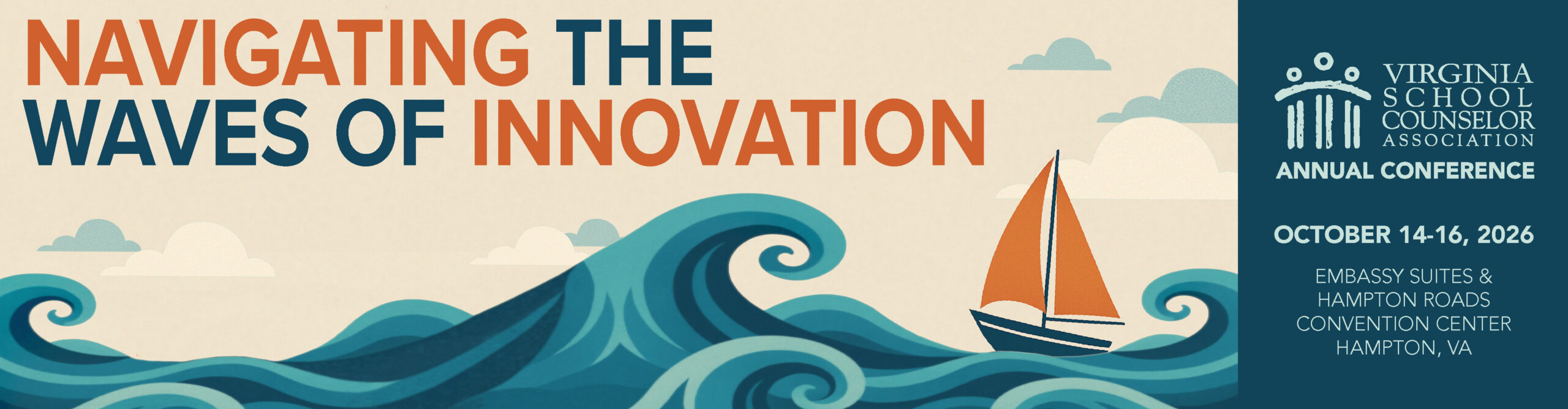
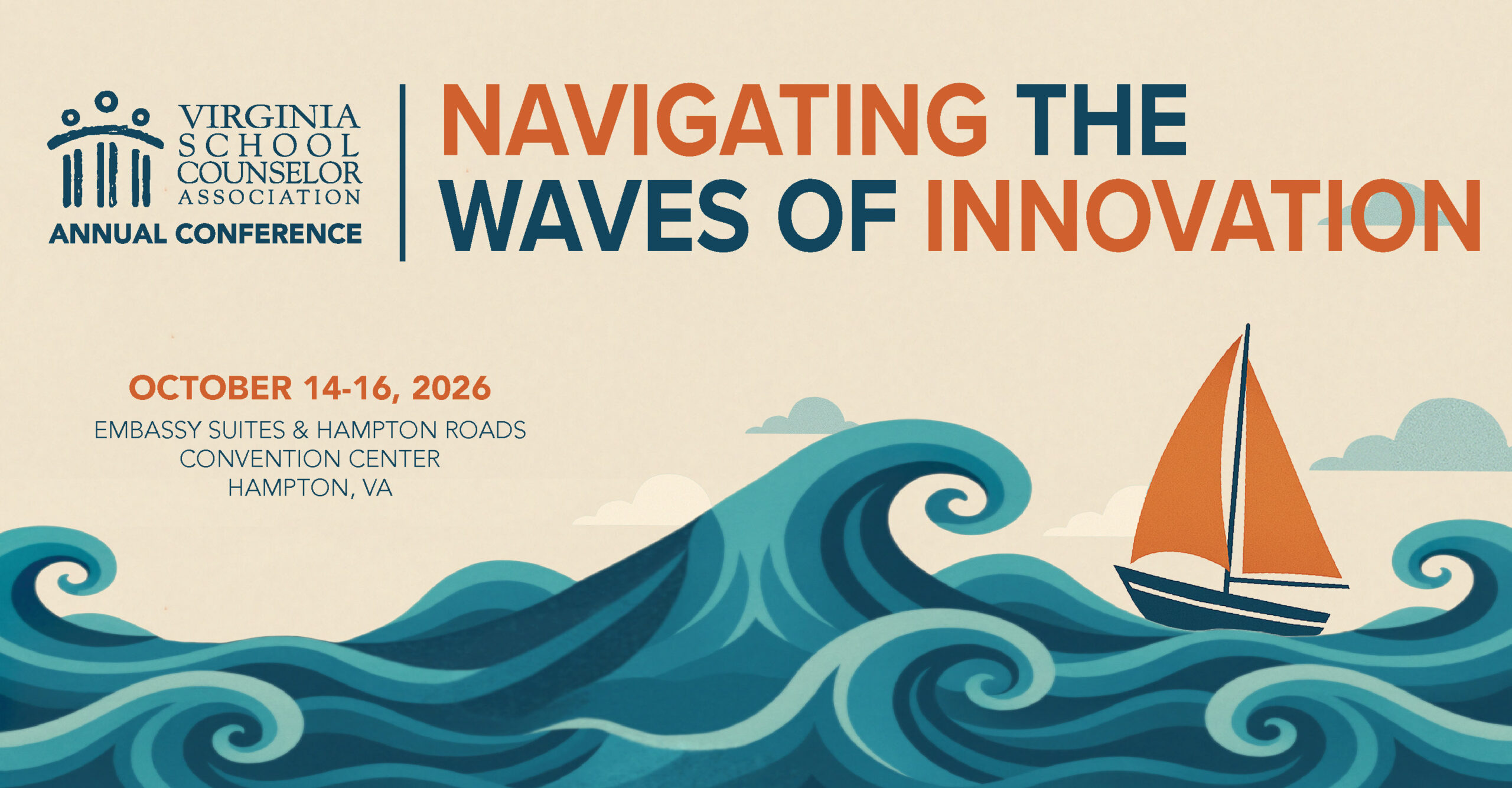
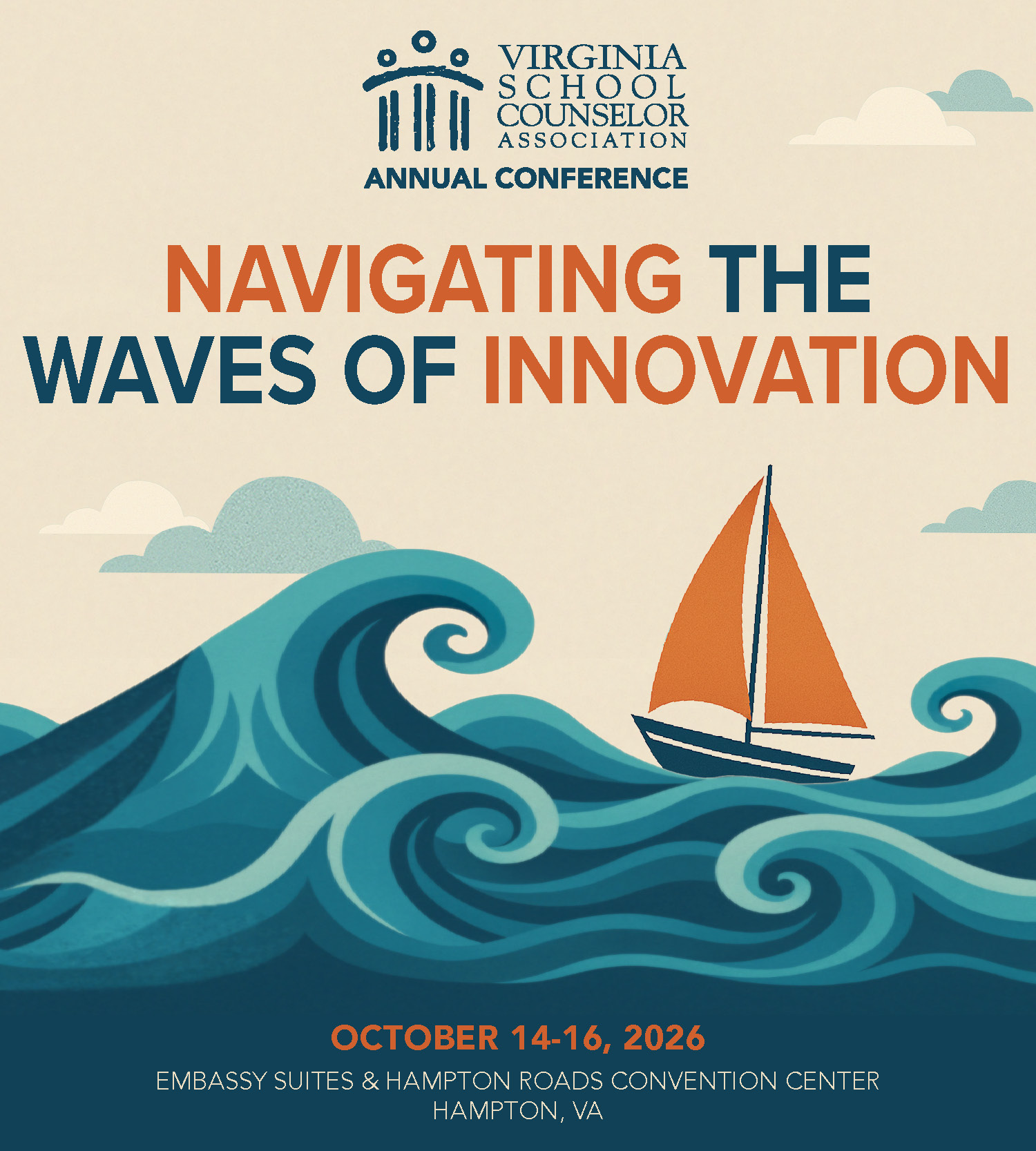
October 14-16, 2026
Embassy Suites & Hampton Roads Convention Center
Hampton, VA
We hope to see you next year!
Lead Presenter: Ashley Sanchez Garcia
Career Day is a wonderful experience for students to connect what they are learning in their career exploration units to real-world jobs while connecting with community members. As school counselors, we work collaboratively with a variety of stakeholders to advance and enhance our impact on a larger scale. Attend this session to learn about a school counselor’s experience planning Career Day, gain resources, build partnerships, email templates, and tips for advocacy.
Lead Presenter: Julie Diaz-Castillo
Educators across the United States encounter unprecedented levels of stress, burnout, and secondary trauma each school year. Concurrently, families and community-based mental health providers are navigating various pressures while striving to support student well-being. This session explores how school leaders can create environments that prioritize staff well-being as a foundation for student mental health.
Lead Presenter: Miranda Hagerman
Counselors can assist teen parents find opportunities that help them work towards their goals while being mindful of their situation. Working with them can be time-sensitive, but counselors can make an impact even with a tight deadline. Teen parents navigate the path to their post-graduation differently. In this session the focus will be on how establishing rapport, taking a positive interest in their situation, and figuring out their support system make a difference for these students.
Lead Presenter: Blake McGaha
Wellness and prevention aren’t the same job, but they share the same toolbox. This session treats them as two halves of one strategy: proactively building belonging, purpose, and self-awareness so students thrive, while using those same skills as protective factors that catch risk early. Leave with concrete ways to build both into your school day — everyday wellness routines that help students flourish, and a data-driven way to flag who needs support before a crisis hits.
Lead Presenter: Dr. Steven Coyle
Today’s students are different—and that’s not a bad thing. They’re questioning the cost of college, seeking meaningful work, and showing real interest in careers in the skilled trades. In this session, you’ll gain insight into Gen Z’s evolving mindset and get practical tools to help them explore high-tech, high-demand career paths. You’ll leave with a new perspective, a free skilled trades resource, and a renewed connection to your role as a guide—not just a scheduler
Lead Presenter: Natalie Spencer Gwyn
School counselors often encounter students with a variety of behavioral and mental health concerns throughout a day. Mindfulness and mindful interventions have been shown to help students by introducing a variety of skills, such as guided imagery, mindful breathing, and gentle yoga. This presentation is designed to give school counselors tools to implement mindful techniques and help empower students discover their true potential. It will be an exciting and hands on presentation that will introduce counselors to mindfulness techniques and strategies to help all students succeed.
Lead Presenter: Meghan Brubaker
Before learning can occur, students need to feel safe, supported, and a sense of belonging. Join this session to explore effective techniques for feeling identification and strategies to help students navigate the waves of their emotions. Participants will gain practical resources, visuals, and tools to support emotional regulation through mindfulness, breathing exercises, and developmentally appropriate methods for helping students recognize and express their feelings.
Lead Presenter: Sandra Rucker
This session will focus on ways school counselors can support English Learners (ELs) through advocacy, collaboration, and culturally responsive practices. Participants will explore the barriers that EL students may face, strategies to increase family engagement and sense of belonging, and practical ways to support student success. Attendees will leave with resources, advocacy ideas, and strategies to support EL students, families, and staff.
Lead Presenter: Patricia Kreseski-Lisi
You’ve tried attendance phone calls and e-mails, you have sticker charts, and Check-in/Check-out, but you’re not seeing the attendance results that you want. In our presentation, see how we were able to finally decrease our chronic absenteeism by focusing on tier 2 interventions. Get an up-close glimpse into our K-5 toolkit of programs that we implemented in our school to cultivate leadership and connection among elementary students, ultimately positively increasing attendance.
Lead Presenter: Loren Dittmar
Supporting others can be deeply meaningful—and deeply exhausting—especially when personal hardships collide with professional demands. In this powerful session, Loren explores how vulnerability can fuel resilience, deepen connection, and renew your sense of purpose. Walk away with practical tools and a fresh perspective on how life’s toughest moments can strengthen both your work and your well-being.
Lead Presenter: Lisa King
Do you ever wonder WHY our kids act the way that they do? This session will talk about figuring out the goal behind the behavior. And by understanding these goals, figuring ways to address the behaviors much more efficiently and with much more success. This session will cover the goals that children typically have for acting out such as looking for attention or wanting to be in control. Tune in to learn some strategies and ideas to help understand more about why our kids act the way they do and what we can do to help.
Lead Presenter: Renita Rich Bren
This workshop is designed specifically for professional school counselors who play a pivotal role in guiding students and families through the college planning process. With the rising cost of higher education, counselors are on the front lines of equipping students with the knowledge and resources to pursue a college education without the burden of excessive debt. This interactive session will provide counselors with a toolkit of strategies, programs, and best practices.
Lead Presenter: Katlyn Kegley
What happens when school counseling meets improv? Students open up, take risks, and build confidence. Participants will learn quick, engaging, and empowering improv strategies that can help students manage anxiety, explore emotions, connect with others, and step outside their comfort zones.
Lead Presenter: Quanetra Carney
This session will highlight how a comprehensive middle school career counseling program is intentionally aligning with Virginia’s newly adopted fourteen career clusters. Designed with equity, access, and engagement in mind, this presentation will showcase how career exploration is embedded into classroom lessons, small groups, and school-wide initiatives to ensure all students develop meaningful awareness of career pathways early on.
Lead Presenter: Dannette Beane
Many students enter college with adverse childhood experiences (ACEs). This presentation highlights a case management model at a public university providing advocacy, counseling, recovery support, emergency funds, housing assistance, financial aid, and food security resources that wrap around students while enrolled. Presenters will share outcome data, student testimonials, and the role of grants in supporting this work.
Lead Presenter: Brooke Marshall
Do you struggle to plan and implement effective small groups with young students? School counselors often receive referrals for students struggling with emotional regulation and social skills. It can feel overwhelming to determine what to teach and how to run these groups effectively, especially when many of these students struggle with focus and dysregulation. In this session, you will learn to design engaging and effective small groups that focus on building skills and confidence!
Lead Presenter: Christy Welch
Discover how school counselors can turn belonging from a buzzword into daily practice through intentional, schoolwide programs and partnerships. This session will share practical ideas for strengthening attendance, engagement, student wellness, school culture, and staff connection. Participants will reflect on what they already do well and leave with adaptable strategies to help every student feel seen, valued, and connected.
Lead Presenter: Natalie Spencer Gwyn
School counselors often encounter students with a variety of behavioral and mental health concerns throughout a day. Mindfulness and mindful interventions have been shown to help students by introducing a variety of skills, such as guided imagery, mindful breathing, and gentle yoga. This presentation is designed to give school counselors tools to implement mindful techniques and help empower students discover their true potential. It will be an exciting and hands on presentation that will introduce counselors to mindfulness techniques and strategies to help all students succeed.
Lead Presenter: Emily Goodman-Scott
We’ve been hearing more and more about neurodiversity in recent years. But, how do we weave this into our school counseling program and MTSS efforts? Come hear about a university/district partnership between ODU and Hampton City Schools- focused on neurodiversity-affirming school counseling. We will share concrete strategies and resources for the elementary, middle, high school and district level. Join us!
Lead Presenter: Wilson Harvey
Student voice is one of the most powerful tools in a school building, and as school counselors, we are specially positioned to drive the charge in centering these voices in the building. In this session, you will hear about how a school counselor and a Science teacher teamed with their administration to build a sustainable, social/emotional Learning-centered model for the collection of both quantitative and qualitative representations of student voice, and then took action to address needs.
Lead Presenter: Katherine Villacorta
Many school counselors provide services to students with disabilities in classes within their buildings. This session will include evidence-based curriculums applicable when implementing small-group counseling with students with disabilities. This session will also include trauma-informed strategies and prevention procedures for teaching classroom lessons in self-contained special education classrooms. Discussion will also include the benefits of collaborating with school-based specialists.
Lead Presenter: Trayva Bradley
ROOTED: Building Confidence Through Creative Counseling introduces participants to affirmation-based counseling strategies that help students develop confidence, resilience, and emotional wellness. Using the R.O.O.T.E.D. framework—Restoring Our Own Thoughts, Emotions & Dreams—this interactive session explores creative SEL experiences, expressive activities, and engaging interventions that empower students to challenge negative self-talk, strengthen self-worth, and grow emotionally rooted.
Lead Presenter: Amy Sainz
Join us in this interactive session to learn how to stop being the “problem solver” and start being the architect of student change. This session will review a high-efficiency, evidence-based framework: Solution-Focused Brief Counseling (SFBC). By shifting the focus from “problem-mining” to “solution-building,” counselors can facilitate measurable student progress in as little as 15 minutes. Participants will walk away with a comprehensive “SFBC Toolkit” for immediate implementation.
Lead Presenter: Sara Crummett
Participants will learn easy to implement and developmentally appropriate strategies to gather data for Kindergarten-Second grade students to measure the students’ connectedness to school and strategies to foster belonging, positive peer relationships, emotional regulation, and safe adult connections through play-based counseling groups. Ideas will also be shared on how to foster school connectedness to upper elementary and middle school students.
Lead Presenter: Beth Fortner
You’ve been asked your “WHY”, but do you know your “BECAUSE”? By applying ASCA-aligned resiliency strategies, you will distinguish between immediate self-care and long-term restorative acts that sustain your professional energy. Participants will walk away with a drafted personal mission statement focused on who they are as individuals and a framework to align career paths with mental well-being for long-term resilience.
Lead Presenter: Loren Dittmar
Supporting others can be deeply meaningful—and deeply exhausting—especially when personal hardships collide with professional demands. In this powerful session, Loren explores how vulnerability can fuel resilience, deepen connection, and renew your sense of purpose. Walk away with practical tools and a fresh perspective on how life’s toughest moments can strengthen both your work and your well-being.
Lead Presenter: Meagan Martin
AI isn’t just a trend, it can be a game changer for school counselors. Learn how to use AI to save time, create engaging Tier 1, 2, and 3 supports, improve communication, and reduce workload while keeping the human connection at the center of counseling. This session will provide practical examples of using AI for lessons, interventions, communication, and organization, along with ethical considerations and best practices for appropriate AI use in schools.
Lead Presenter: Joanna Barney
Looking for practical, easy-to-use resources to strengthen your responsive counseling practices? Together, we’ll build a toolbox with strategies for de-escalation, peer conflict resolution, and other common student needs. Come ready to participate and experience these activities from a student’s perspective. You’ll leave with tools you can use right away!
Lead Presenter: Tori Stone
Counseling should never be boring; it should be engaging and “sticky” enough to stay with students long after the session ends. In this session, we will introduce creative counseling techniques such as the use of movement, chairs, props, metaphors, and writing and drawing that can be used when counseling students of all ages. This fun, interactive presentation will include teaching and the demonstration of the use of creative techniques. Join us and return to school energized!
Lead Presenter: Kristen Bailey-Hardy
Interested in developing an innovative dog therapy program? Join certified dog therapy handlers Kristen Bailey-Hardy, Licensed School Counselor and Sheila Pope, LCSW and learn how to add value and depth to existing SEL programs while increasing academic achievement. Learn how therapy dogs support our students who are struggling the most, while also adding value to our overall school culture. Participants will leave with the information needed to establish a therapy dog program in their school.
Lead Presenter: Don Landis
Most school professionals have not had coursework or PD opportunities addressing support for grieving students. In some school, training addressing bereavement and death is hastily planned, or delivered in a moment of crises – a student or teacher has died, a critical incident involving death has occurred on or near campus, or a tragedy has happened in our community. It’s hard to learn these skills when grieving ourselves…. so let’s start this journey together!
Lead Presenter: Melissa Benavidez
Level Up Virginia (LUV) is a statewide initiative led by the State Council of Higher Education for Virginia (SCHEV) and the Virginia Department of Education (VDOE). As part of our mission to increase postsecondary readiness, enrollment, and completion, LUV offers several free financial aid programs to support high schools and their students, including professional development, student-facing webinars, a FAFSA/VASA application texting line, and more. Come learn what we can offer your school!
Lead Presenter: Nikki Raquedan
Middle schoolers have big feelings, big energy, and occasionally big drama. This session shows how games can tame anxiety, spark goal‑setting, stretch flexible thinking, boost friendships, and help students wrangle those tough emotions all while having actual fun in counseling. Attendees will walk away with ready‑to‑use game ideas, tips for adapting them to different counseling needs, and a fresh appreciation for how play can spark real growth in the middle school years.
Lead Presenter: Darlene Fonville
Career development begins as early as when a child can answer: “”what do you want to be when you grow up?””
Participants will learn how one elementary school successfully hosted a career fair featuring nearly 20 community partners and served over 400 students. Planning and implementing a large-scale event can be challenging. Check out this session for a practical, replicable framework in executing school-wide career development for K–5 students.
“
Lead Presenter: Amanda Gilbert
School counselors often advocate for neurodivergent students, yet many Black and Brown families still experience schools as reactive and difficult to navigate. This session explores strengths-based, culturally responsive strategies to support Black neurodivergent youth in K–12 settings. Participants will examine nontraditional support systems and relational, community-centered approaches that strengthen students’ emotional and social well-being and improve school experiences.
Lead Presenter: Makayla Ivey
This session explores environmental stress and racial discrimination experienced by Black students across educational settings. Participants will discuss how these experiences impact well-being and sense of belonging. The session highlights practical strategies, including community-based and culturally responsive approaches, to foster more supportive and inclusive environments for students.
Lead Presenter: Jennifer Smith
Explore how the NBCT process can elevate your school counseling practice and professional growth. Gain a clear overview of the four components, assessment and portfolio requirements, flexible timelines, and key benefits. Learn how the process strengthens instruction, assessment, collaboration, and reflective practice. Address common challenges including time, writing, and evidence collection. Participants will identify their “why,” assess readiness, and leave with next steps and resources.
Lead Presenter: Inesha K. Howard
Alternative education is anything but one-size-fits-all. Working in these settings challenges educators to think differently, remain open, confront bias, and believe in every student’s potential. This engaging session will explore how school counselors and administrators can effectively collaborate to better support one another and the students they serve. Attendees will leave with practical strategies for meaningful collaboration and actionable steps for successful implementation.
Lead Presenter: Cathleen Beachboard
School counselors play a critical role in supporting student well-being, yet many lack scalable tools to build motivation and resilience. This session introduces psychological hope as a measurable, teachable skill that improves engagement, goal attainment, and mental health. Participants will gain practical strategies and tools to strengthen agency, pathways thinking, and belonging, along with simple methods to track impact and support students proactively.
Lead Presenter: Keesha Kerns
Media exposure is creating unprecedented issues with adverse consequences in the current generation. Youth are being bombarded with social media, news images, and internet events that influence their growth into young adults. The present media factor prompts school counselors to adapt their counseling skill set to meet these challenging dynamics in the current generation while building resilience in students for academic, social, and emotional development fostering success in school and beyond.
Lead Presenter: Dr. G. Cleve Pilot
This dynamic session equips educators with tools and strategies to help students make positive, responsible decisions in and beyond the classroom. Grounded in Dr. G. Cleve Pilot’s Hey, Grover! book, this presentation connects social/emotional learning with practical classroom application. Educators will explore how to guide students in understanding the link between choices, consequences, and character development while fostering a culture of accountability.
Lead Presenter: Caitlin Ivey
This session outlines a strategic approach to advancing social/emotional development by aligning ASCA Student Standards with school-wide priorities (e.g., SIIP, MTSS). We will share how our school transitioned from isolated initiatives to a cohesive tiered system that embeds SEL into the core of our school counseling program. Participants will explore ways to promote high-impact programming that cultivates a greater sense of belonging for every student, ensuring long-term, sustainable growth.
Lead Presenter: Melissa Benavidez
Level Up Virginia (LUV) Events is a series of in-school opportunities, including Virginia College Application Week, ECMC College Nights, FAFSA Next!, and Decision Day, designed to connect high school students to their postsecondary goals.
In addition, the Level Up team will provide information on the new Virginia Community College System (VCCS) Roadshow, a partnership initiative designed to bring high school seniors to a community college near them in the spring.
Lead Presenter: Kim Norton
After over 20 years, I’ve learned that our most valuable resources are our time and energy. I’ll share proven organization hacks designed to declutter your physical office and mental headspace, allowing you to focus on what matters most: your students. From efficient systems for managing lessons and small groups to savvy time-management strategies, you’ll gain tools to boost your daily productivity. Everyone will also walk away with my complete K-5 lesson curriculum to jumpstart their year!
Lead Presenter: Deborah Lucas
Every senior has a unique vision for their senior year and life after graduation. This presentation showcases how we created a “one-stop” Senior Night experience that gives an overview of expectations & opportunities for their senior year. It honors all postsecondary pathways- whether students plan to enter the workforce, enlist in the military, pursue a trade, or attend a two/four-year college or university. This event helps students & families explore options & leave with a confident plan.
Lead Presenter: Tiffany Myers
This presentation explores integrating Registered Play Therapy into school counseling programs to support students’ emotional, social, and behavioral growth. Participants will learn how play-based interventions help children process emotions, build coping skills, strengthen relationships, and improve school success. Special guest Dr. Sharon Silverberg will share information about the Registered Play Therapy certification program at Old Dominion University.
Lead Presenter: Erica Daniels
School counselors play a vital role in shaping the next generation of the profession by serving as internship site supervisors. However, many counselors step into this role with limited guidance on how to prepare their school, students, and themselves for supervising interns. This session is for current and aspiring site supervisors to share a clear, practical framework for welcoming, mentoring, and supporting internship students while maintaining ethical, legal, and programmatic standards.
Lead Presenter: Katie Mihaly
Discover how STEAM can be reimagined through a school counseling lens: Social Skills, Teamwork, Empathy, Academics, and Mindset. This session will explore hands-on STEAM-based activities for students that school counselors can utilize in classroom lessons, small groups, and individual counseling sessions. Get ready to leave with practical, low-prep ideas and lessons that help students build connection, emotional regulation, and problem-solving skills through creative counseling activities.
Lead Presenter: Katlyn Kegley
When a child expresses suicidal thoughts, school staff are often left asking, “What do I do now?” This presentation offers practical strategies to support students experiencing suicidal ideation, including adapting risk assessment and safety planning tools for children with diverse needs. Participants will gain concrete tools to identify warning signs, complete risk assessments, make appropriate referrals, and support students and stakeholders within the school environment.
Lead Presenter: Claire Handville
Artificial intelligence is reshaping education and school counselors are uniquely positioned to harness its potential to expand impact and deepen impact. Explore how AI can increase efficiency, strengthen ASCA-aligned programming, and expand student support while maintaining ethical standards and professional judgment. Participants will learn practical applications for program data, program planning, and individualized supports, and leave with ready-to-use prompts and implementation strategies.
Lead Presenter: Paul Harris
Black male student-athletes often hypervisible as athletes and invisible in their full humanity. This session illuminates how school counselors can disrupt identity foreclosure, challenge racialized misreadings, and promote college, career, and life readiness. Participants will leave with tools to build culturally responsive relationships, collaborate with families and coaches, and create school ecosystems where Black boys are seen, affirmed, and supported as whole people—not just athletes.
Lead Presenter: Kimberly Turnage-Garland
Intervention Counselors are a specialized role in Hanover County Public Schools. With a focus on prevention, our efforts also include School-Wide programming, classroom lessons, group counseling, and more! Come learn about how you can incorporate substance use prevention in your School Counseling Program.
Lead Presenter: Rae Martz
School counselors are doing meaningful work every day while navigating competing demands and expectations. But how do you know what students need, what is working, and where to focus next? This session explores practical ways to use data to connect student needs with intentional action and evidence of change. Participants will gain strategies to make informed decisions, strengthen advocacy, and show how school counseling contributes to meaningful outcomes for students.
Lead Presenter: Cheryl Chappell
School counselors share critical information, yet gaps in follow-through persist. This session explores how strategic, action-driven communication, combined with collaboration among school counselors, graduation coaches, and administrators, can improve senior outcomes. Participants will gain practical strategies, sample messaging, and a replicable framework to increase student accountability, strengthen family engagement, and support on-time graduation.
Lead Presenter: Madison Rayburn
Small groups can be an ongoing struggle for a busy school counselor. So much potential yet often squished into a lunch period. Sometimes, it can feel like what is taught gets left in the counseling office. How do we make intentional choices to have clear and memorable small groups? Attend this session to learn practical, innovative approaches to your small group structure and delivery, using Universal Design for Learning practices. Let’s work to make small groups stick.
Lead Presenter: Jim McMullen
Inspired by Fred Rogers’ vision of neighborhoods where every child feels safe, known, and valued, this session helps school counselors build “neighborhoods of care” through SEL and relational practices. Participants will explore practical strategies such as rituals, affirmation scripts, and community-building routines to strengthen belonging, emotional literacy, and school climate across Tier 1–3 supports.
Lead Presenter: Amy Carroll
Join Loudoun County Public School’s counselor and counseling director to learn how we increased underrepresented student enrollment and success in dual enrollment (DE) university and AP coursework. This presentation will feature our work with universities to open access to the university sponsored DE courses; ensuring that university, district, and classroom teachers support open student enrollment and provide the scaffolding EL and underrepresented students need to be successful.
Lead Presenter: Lydia T. Larimore
With rising demands, chronic stressors, and emotional toll of supporting students and families in increasingly complex environments, this session reframes wellness not as another task, but as a professional anchor in ethical, relational, and effective practice. Drawing from humanistic, relational‑cultural, and trauma-informed perspectives, and honoring counselors’ lived experiences, participants will leave with evidence‑informed strategies to restore capacity and maintain professional wellbeing.
Lead Presenter: Peggi Trusty
School counselors are asked to support students academically, socially, and emotionally—often at the expense of their own well-being. This session offers practical, sustainable wellness tools to help counselors manage stress, prevent burnout, and maintain effectiveness. Participants will explore simple strategies that support personal resilience while strengthening their capacity to serve students consistently and compassionately.
Lead Presenter: Chelsea Boateng
This session explores how Behavior Support Teams can leverage Google Forms, Sheets, and data dashboards can reduce administrative workload and strengthen MTSS decision-making. Participants will learn how behavior referral data can automatically organize by student, behavior type, grade level, and trends, allowing teams to quickly identify needs, respond with targeted Tier 1–3 supports, and spend more time delivering timely, student-centered interventions.
School counselors: are you looking for tools, tips, and strategies? We have the session for you: the VSCA Smackdown! In this fast-paced and high energy session, school counseling graduate students from 7 different VA universities provide concrete tools and ideas, including a Google Drive folder of resources. Come join us to get some tools you can use, and cheer on the next generation of school counselors!
Lead Presenter: Sarah Ritchie
Research shows that early exposure to various careers positively impacts students’ academic achievement, career aspirations, and overall success in the workforce. Through play-based learning, children engage in hands-on experiences that enhance their cognitive, social, and emotional development, making it an ideal approach for introducing them to the world of work.
Lead Presenter: Shannon Bond
Group chats have become the new hallway, cafeteria, and social battleground for students. Today’s school counselors are increasingly responding to emotional crises rooted in online peer conflict that continues long after the school day ends. This interactive session will explore how digital communication reshapes adolescent relationships and intensifies peer conflict. Attendees will leave with practical, school-based strategies to support students while in digital conflicts.
Lead Presenter: Beth Fortner
The WHY and the WHAT we do must be intentionally blended to ensure our counseling practices are clinically sound. Discover how the HEART acronym transforms the ASCA School Counselor Competencies into actionable practice. This session explores Holistic Advocacy, Ethical Excellence, Accountable Leadership, Responsive Relationships, and Transformative Tools.
Lead Presenter: Denise Schmitter
When students melt down, they are expressing a need for help with regulation, not choosing to misbehave. This session explores the counselor’s role in implementing portable calming kits school-wide. Participants will learn items to include, strategies for teacher buy-in, ways to empower students, and how to set classroom expectations. The focus is on self-regulation as a learned skill and shifting school culture to view these tools as supports for learning, not punishment.
Lead Presenter: Jennifer Perry
School counselors learn theory in training but may struggle to apply it in school settings. Using one layered student case, we will demonstrate how different counseling perspectives shape conceptualization, decision-making, and advocacy efforts. Participants will explore how theoretical lenses influence counselor responses and leave with practical strategies for using theory to support intentional, student-centered, and equity-focused school counseling practice.
Lead Presenter: Jane Kim
Artificial intelligence is rapidly reshaping education, yet many schools lack clear guidance for responsible implementation. This session explores how AI and engagement-driven technologies affect student development, mental health, relationships, and equity in schools. Drawing from research, developmental psychology, and lessons from rapid digital adoption during COVID, participants will gain practical frameworks to help schools approach AI with greater clarity, balance, and confidence.
Lead Presenter: Audra Lancaster Boyce
Continue the journey toward becoming a master counselor and impactful school leader. This session explores how to “level up” your practice through advanced leadership, advocacy, and systems-level strategies that strengthen school culture and improve student outcomes. Participants will explore practical tools for collaboration, data-informed decisions, mentorship, and professional growth, learning to turn everyday counseling work into meaningful change and expand impact across school communities.
Lead Presenter: Jamie Jackson
Food insecurity and stigma kept students from using available support—so we reimagined everything. Learn how our counseling team transformed a failing, prepackaged program into a student-centered pantry serving 50 students weekly. Discover how choice, dignity, and relationships turned a simple resource into a trusted support system—and leave with practical strategies and tools to build and sustain your own.
Lead Presenter: Deanna Ford
High school counselors must deliver meaningful career exploration while managing large caseloads. This session provides ready-to-use, evidence-based “quick win” strategies that require minimal prep and yield high impact. Participants will explore Tier 1 activities that build career awareness, align with American School Counselor Association Mindsets & Behaviors, and support postsecondary readiness through lessons, advisory, and existing school structures.
Lead Presenter: Brian Wesley Harrington
Most school counselors only receive administrative supervision from a building principal, leaving clinical growth unsupported. This session introduces peer supervision as an innovative, evidence-based, and immediately actionable alternative. Participants will explore the Collegial, Competent, and Consultative (CCC) framework and leave with strategies to launch peer supervision to aid in reducing burnout, strengthening professional identity, and increasing self-efficacy.
Lead Presenter: Brooke Kirtner
Wondering how to tackle the tardy epidemic without taxing your own time? Born out of the Behavior Solutions research, leave this session with a one-and-done style tier 2 intervention thoughtfully designed to connect motivation, data, behavior, and goal setting. Counselors will leave the session empowered to partner with school leaders to address tardiness. Participants will receive survey questions, small group plan, and templates required to run similar interventions in their building.
Lead Presenter: Allyson Markussen
This presentation explores how to build or enhance a community-focused Comprehensive School Counseling Program (CSCP) while maintaining sustainability and preventing burnout. Participants will learn practical strategies for supporting students, collaborating with teachers and administration, and engaging parents to extend the counselor’s impact. The session introduces key points of focus that helps prioritize services, maximize reach, and create a balanced, effective counseling program.
Lead Presenter: Sarah Henry
In this session, we will discuss how to apply various counseling theories in school counseling. We will discuss reality, person-centered, ecological, advocating student-within-environment, cognitive behavior therapy, existential, solution focused, and adlerian theories–and their applications to how school counselors design and deliver a SC program. This will include how theory may impact what school counselors measure, how they advocate, and how they design curriculum!
Lead Presenter: Meg Gladieux
Grieving students exist in all schools, yet supporting them remains a challenge. Using the Dual Process Model, this session explores how loss impacts youth across their K-12 experience, including secondary losses, how loss circumstances shape grief, and common misconceptions about bereavement. Participants will leave with a toolkit of small group and individual activities focused on expressing emotions, preserving memories, and coping strategies aligned with best practices.
Lead Presenter: Shekila Melchior
We continue to pathologize the normal emotional responses of children and teens who arrive in counseling with Tik Tok diagnoses that become explanation and excuse for all behavior. Over accommodation in schools has intensified this trend. Liberation therapy reminds us that children are not their diagnoses, but reflections of the systems they navigate. We propose a healing centered approach: a culturally rooted, strengths based framework that centers development and restores identity.
Lead Presenter: Betty Mendoza
This session examines barriers underserved youth face in accessing community resources, particularly those at risk for or involved in the juvenile justice system. Drawing on qualitative research, participants will explore gaps in awareness, availability, and access to services. School counselors will gain practical strategies to connect students and families to mentorship, after-school, and mental health supports to improve outcomes.
Lead Presenter: Keyoshia Liverman
School counselors face rising mental health needs with limited resources. This session presents a practical, research-informed MTSS framework integrating mindfulness and CBT strategies to expand support. Participants will gain actionable tools to implement tiered interventions that improve emotional regulation, access to care, and student outcomes.
Lead Presenter: Caitlin Keller
Being a new school counselor can feel overwhelming as you transition from graduate school to real world learning in your new role. This occurs while balancing student support with administrative duties while navigating new data systems and innovative technologies. This presentation offers actionable takeaways, including confidence-building strategies, organizational resources and system-strengthening tools to help you navigate your first years with less stress and greater impact.
Lead Presenter: Krystal Clemons
School counselors are uniquely positioned to shift how schools see and engage families. Too often, Black families are positioned as participants on the margins rather than partners at the center, their strengths reframed as deficits, their wisdom overlooked. This session draws directly from It Takes a Village to Raise a Classroom: Black Family Wisdom in Education and Dr. Tara Yosso’s Community Cultural Wealth framework.
Lead Presenter: Jane Kim
Across the country, educators are seeing the effects of social media on student attention, behavior, relationships, and mental health long before the first bell rings. Yet many responses fail to address the root cause: engagement-driven technologies designed to capture attention. This session explores how social media shapes student behavior and school culture and shares practical strategies that build student agency, healthier digital habits, and stronger school communities.
Lead Presenter: Dan St. Romain
Although behaviors in the school system have changed a great deal in the past few decades, our strategies for supporting those behaviors have not. By examining all the information we have learned about the brain, we are in a better position to design effective interventions. In this fast-paced session, participants will learn nine principles for positively shaping the behavior of our students.
Lead Presenter: Dr. G. Cleve Pilot
Ready to Lead: Why Soft Skills Matter in Elementary School is a session designed for educators, school counselors, and youth mentors who want practical strategies for teaching soft skills, leadership behaviors, and positive decision-making to students in elementary school. Demostrating how the Hey, Grover! book and activity guide can help students develop the foundational life skills that support academic success, healthy relationships, and long-term career readiness.
Lead Presenter: Erin Hurley
This session explores the connection between nature and student mental health through research, hands-on wellness experiences, and innovative school counseling strategies. Participants will explore restorative, nature-based practices that promote student well-being and gain practical, ready-to-use ideas for weaving nature-informed approaches into a comprehensive school counseling program.
Lead Presenter: Crystal Hatton
Military-connected students often demonstrate remarkable resilience and perseverance. However, they can experience significant challenges related to their caregiver’s military service. Thus, it is important for school counselors to be mindful of best practices to support military-connected students to positively impact their overall development.
Lead Presenter: Demere Coker
This presentation examines how adultification of Black children, perceiving them as older and less deserving of care is rooted in systemic bias and shapes school experiences. Using Cultural Betrayal Trauma Theory (CBTT), participants will explore how trauma within marginalized communities impacts trust and support. Practical strategies, including somatic and expressive approaches, will be introduced to help school counselors respond effectively.
Lead Presenter: Krystel Santiago
School Counselors balance student support, SEL lessons, parent communication, documentation, data, and schoolwide responsibilities while often feeling overwhelmed and short on time. This practical session will show counselors how to use AI ethically and responsibly to improve organization, streamline repetitive tasks, support counseling program implementation, and save time while maintaining meaningful student connections.
Lead Presenter: Jo-el Cox
As schools grow more linguistically diverse, counselors must navigate new waves of communication and cultural understanding. This session highlights innovative practices that empower multilingual learners and families. Attendees will explore strategies to foster belonging, bridge language gaps, and create inclusive counseling models that promote access and excellence for all students.
Lead Presenter: Lawrence Holloway Jr
Students in alternative school settings are among the most vulnerable and underserved in our education system — yet school counselors in traditional settings often feel underprepared to support them before, during, and after placement. This session draws on direct experience to offer practical, relationship-centered strategies for bridging this critical gap through a restorative practices lens.
Lead Presenter: Kelley Doswell
This session explores the NBCT journey through the lens of a practicing school counselor. Participants will examine the four components, five core propositions, and 11 School Counseling Standards; discover how National Board Certification elevates equity, advocacy, and reflective practice; and identify concrete next steps toward candidacy — especially in under-resourced, urban school communities. Activities and handouts will be provided to the audience.
Lead Presenter: Beatrice Darden-Woody
Recognition of mental health issues by health and medical professionals has reached a national awareness level. In addition to learning their prospective professions, graduates of health and medical programs need supplementary multicultural competency underpinnings through coursework to service their prospective populations and become more effective practitioners with mental health training.
Lead Presenter: Alivia Evans
High-achieving and gifted students are often viewed as successful, yet many experience internal pressure, perfectionism, and impostor syndrome that go unnoticed. This session explores the disconnect between academic performance and emotional well-being and provides school counselors with practical, culturally responsive strategies to support identity development, reduce anxiety, and promote sustainable success.
Lead Presenter: Audra Lancaster Boyce
Discover how school counselors can foster student resilience through reflection, creativity, music, and culturally responsive practices. This engaging session explores current research on resilience, the role of music in youth development and healing, and the unique ways counselors can create supportive environments. Presenters will share meaningful experiences and creative strategies to deepen student engagement and enrich counseling practices.
Lead Presenter: Kimberlita Casper
From Referral to Role Model: Building Student Mentors Through My B.U.D.D.Y. introduces a 20-minute, lunch-bunch style program that transforms students with behavioral challenges into peer mentors. Participants will learn how to build leadership, responsibility, and empathy through interactive activities. Attendees will leave with access to two ready-to-use lessons and practical tools to improve student behavior and school climate.
Lead Presenter: Riley Phillips
Navigating the changes in higher education are keeping most of us on our toes, but can also feel like being left with more questions than answers. How can high school and college counselors work together to best support the next generation of learners? What are some of the changes and challenges impacting higher ed? Attend this session to hear more from college admissions counselors with conversation, recommendation, and resources so we can navigate the changes in higher education together.
Lead Presenter: Haden Parrish
This presentation highlights the development and implementation of an 8-week psychoeducational Guys Group for male students in grades 8–12. Participants will explore strategies for supporting teen boys navigating masculinity, healthy relationships, family dynamics, identity, body image, and mental health. Attendees will gain practical tools for implementing student-centered small groups that promote emotional wellness, peer connection, and personal growth within a school counseling program.
Lead Presenter: Erin Whitt
In the age of social media, students often bond over “brainrot” rather than meaningful conversation. This disconnect affects relationships and learning both inside and outside the classroom. Structured sharing during classroom lessons helps students build connections, develop cultural competency, and practice speaking and listening skills. In this session, participants will explore practical strategies to strengthen students’ conversation skills and support their social and academic growth.
Lead Presenter: Ivory Turner
When Emotions Run High: Emotional First Aid for Families is a hands-on session designed to equip school counselors with practical tools they can share with caregivers during stressful emotional moments at home. Participants will explore a simple emotional first aid framework, learn ready-to-use caregiver language, and examine low-cost sensory and regulation supports such as feeling wheels and calming prompts. Counselors will leave with strategies they can use in parent workshops, etc.
National Center for Youth Issues
ATTN: VSCA
P.O. Box 22185
Chattanooga, TN 37422-2185
All intellectual property rights in and to the Virginia School Counselor Association (VSCA) Annual Conference (“the Event”), the content and all materials distributed at or in connection with the Event are owned by VSCA and/or the Event sponsors or speakers presenting at the Event. You may not use or reproduce or allow anyone to use or reproduce any trademarks or other trade names appearing at the Event, in any Event content and/or in any materials distributed at or in connection with the Event for any reason without the prior written permission of VSCA or the presenting speaker.