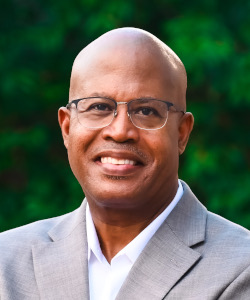
Few voices in K-12 education command a stage like Dr. John W. Hodge. He turns research into results, and audiences leave his sessions with strategies they can use the moment they walk back into their schools.
His path began in the 7th Infantry Division of the United States Army, where discipline and purpose shaped the educator he would become. He received his formal training at North Carolina A&T, Chapman University, and finally Virginia Tech, where his research focused on student resilience and the factors that drive academic success for students from economically challenged communities.
Dr. Hodge has lived the work from every angle. Over his career, he has served as a classroom teacher, AVID instructor, district initiative leader, Associate Director of AVID Center Eastern Division across 13 states, and Director of An Achievable Dream Academy, a high performing school in an economically challenged urban area. Today he serves as Chief Inspirational Officer of AADULLC, formed through a strategic merger of ULLC and An Achievable Dream, carrying the message of academic excellence for all children to educators and stakeholders across the country.
John Hodge is also the author of multiple books, including You Can Get in the Way and Resilience By Design, which empower and equip educators to create thriving school communities.
When Dr. Hodge takes the stage, people change for the better. Teams reconnect to their purpose, leaders find new clarity, and the audience walks away believing again. Hundreds of thousands of children across the United States, South America, and Canada have been positively impacted by the work of Dr. John W. Hodge.
The education of America’s youth is a challenging prospect when one considers the many burdens faced by impoverished children and their families. Research indicates that poverty need not be a barrier to academic excellence. As co-author of the book Standing in the Gap, Dr. Hodge states, “Across the nation, schools are demonstrating that it can be done: That students can reach high standards, that all children can succeed, that the gap between white and minority students, poor and affluent, can be closed.” More often than not, one caring adult can make all the difference in the world. This presentation will encourage all of us to BE THE ONE.
The jobs our students will hold may not exist yet. Memorization will not carry them. Thinking will.
The workforce is changing faster than the curriculum. Employers no longer reward recall. They reward analysis, problem solving, and the ability to learn something new under pressure. When schools teach to the bottom of the thinking scale, they graduate students into a market that has already moved on.
Dr. Hodge bridges theory and the classroom using the foundational work on cognitive rigor from Bloom, Costa, and Webb, updated for today’s classrooms in Anderson and Krathwohl’s revised taxonomy and in Hess’s Cognitive Rigor Matrix. He shows teachers how to raise the level of thinking in any subject, and how to check for it.
Those same skills now decide who can work with artificial intelligence and who gets left behind. A weak thinker types a vague request and takes whatever the machine returns. A strong thinker frames the problem, asks the sharper question, and judges the answer against what good looks like. That is prompt engineering, and it is higher order thinking pointed at a new tool. When students learn to think at that level, they gain the productivity and efficiency today’s job market rewards, and they put AI to work for them instead of being replaced by it.
This is not abstract for Dr. Hodge. He co-authored a 17.7 million dollar Workforce Development grant proposal for Hampton University, work built on preparing people to think for a modern economy. Higher order thinking was also a key ingredient in securing more than 5 million dollars in GEAR UP funding for a large urban school district, funding tied to raising the college and career readiness of low income students.
Teachers leave with question stems, task models, and quick assessment techniques they can drop into Monday’s lesson in any content area. The shift is in the design of the questions, not in the purchase of a product. This keynote is designed to raise the level of thinking in every classroom, using questions teachers already have the power to ask.
Best for: Instructional staff, curriculum teams, CTE and college readiness programs.
Build unshakeable students by turning your school into a place where students lift each other.
Student mental health, chronic absenteeism, and educator burnout are all pulling in the same direction at once. Most responses ask exhausted adults to carry the burden alone. That approach burns people out. Resilience has to live in the culture, and culture is built by everyone in the building, students included.
Dr. Hodge’s newest book, Resilience by Design: Build Unshakeable Students Through Intentional Practice (National Center for Youth Issues, 2026), gives schools a plan. Ten core values, taught and practiced through short structured sessions called Heart Huddles, across grades 3 to 5, 6 to 8, and 9 to 12. The approach rests on a finding most programs miss. When a national experiment followed more than 12,000 ninth graders across 65 schools, the effort to build student mindset worked best where peer norms carried the message (Yeager et al., 2019). That is the whole point. Adults set the tone, but students hold the culture in place, and when they reinforce the values with each other, the change lasts.
Heart Huddles are short, scripted, and grade banded conversations. A teacher can run one without a new curriculum or a new line on the budget. These conversations can take place during morning meetings, advisory periods or pre-dismissal activities. The schedule is up to you. The values give a school a shared language within the first month. Students become carriers of the culture, so the work does not depend on a few heroic adults to survive the year. This keynote is designed to provide staff with a shared language and a repeatable practice they can start the very first week, so resilience stops being a poster on the wall and becomes the way the building runs.
Best for: District and building leaders, full staff kickoffs, counselor and MTSS teams.
Resilience has never been more important than it is right now in America’s schools and communities, many of which are still recovering from the risk-factors exacerbated by the Covid-19 pandemic. Today, and in the near future, schools must be purposeful in their efforts to foster resilience in students and staff. In the book, You Can Get in the Way, Dr. Hodge defines resilience in the following way: “Resilience refers to the ability to avoid, navigate, bounce back from, get through, get over, go around, or survive adversities of all kinds.” This session is the perfect way to inspire your school district, schools and/or community stakeholders to take action. In this session, Dr. Hodge provides an overview of the book along with very practical solutions to help buffer the risk-factors that traditionally hold kids back. It’s the perfect launch for a new school year, or a needed boost during the tough months that follow. After being shared with over 800 educators in a state-wide conference, this session has already been described as “life-changing” by many of those lucky enough to hear it.
Throughout the nation, schools are seeking best practices in school improvement to increase student achievement for all students as we meet the demands more rigorous academic standards. Successful schools have determined that highly engaging instruction with a standards-aligned curriculum focus, driven by meticulous data analysis, are the keys to success in this high stakes testing environment. The development process for the most effect school action plans is a six-step model:
This simple yet effective process has been used by thousands of educational leaders to align intention with effective action, ensuring that all students reach their full potential.
S.A.M.E. stands for Social, Academic and Mindset Education. It is a holistic approach to creating and sustaining academic excellence in today’s schools. S.A.M.E. provides a research supported, holistic view of school improvement by addressing all of the components of school and district culture which must be addressed if lasting school reform is to be attained, i.e. the Social Domain, the Academic Domain and the Mindset Domain. As the rigor of state accountability measures increase, schools must focus their efforts to achieve and sustain academic excellence. Come learn how this approach has been particularly successful in schools serving economically challenged communities.
Discover how to unlock student potential through motivational interviewing! Join Dr. John W. Hodge as he demonstrates how the SAME framework—Social, Academic, and Mindset Education—transforms motivational interviewing into a powerful tool for addressing student challenges. You’ll learn to explore student behaviors, strengthen teaching and learning strategies, and transform belief systems that drive student actions. This session connects motivational interviewing with resilience research, offering evidence-based strategies to build supportive relationships with students facing adversity. Leave equipped with practical, actionable techniques you can implement immediately to help every learner thrive. Don’t miss this opportunity to revolutionize your approach to student engagement and success!